7 Steps to Stop Your Dog Lunging and Barking
Quick Summary
Stopping a dog's lunging and barking on walks means working below its trigger threshold, creating space early, and rewarding calm behaviour. Retraining is gradual: short, frequent sessions with small, high-value treats, moving closer to triggers only as fast as your dog stays calm.
Lunging is often over-arousal rather than aggression, so reactions usually come before the dog can think.
Watch for early stress signs such as a stiff body, a hard stare, raised hackles and a tight, fast tail.
Cross the road or turn around early so your dog never reaches the reaction point.
Practise loose-lead walking in short sessions, since a tight lead signals tension.
Log how close you can get before your dog reacts each week, and expect setbacks.
Table of Contents
Why Your Dog Lunges and Barks at Other Dogs and People
Last Updated: October 30, 2026
Nigel Reed
Lunging and barking on walks is one of the most common problems we see with German Shepherds in Reading and across Berkshire. It is stressful, but this behaviour can be changed with the right plan.
Lunging is often a sign of over-arousal, not aggression. If you have a German Shepherd, you can read why this breed reacts to other dogs in our guide on why German Shepherds bark at other dogs. Your dog sees a trigger, such as another dog or a stranger, and reacts before it can think. Barking often comes from the same place, mixed with frustration or fear.
Understanding what drives the behaviour is the first step. Common triggers include:
Other dogs on the pavement or in the park
People approaching quickly or from behind
Doors, gates, and passing cars
Bikes, joggers, and running children
Watch your dog's body language closely. You can learn to recognise these signals in our guide to reading reactive dog body language. Early signs of stress include a stiff body, a hard stare, raised hackles, and a tight, fast tail (Understanding Your Dog's Body Language - RSPCA). Notice these before the lunge happens, and you can act sooner.
Step-by-Step: Retraining Lunging and Barking on Walks
Work through these steps in a quiet area first, then build up slowly. For a deeper guide, see our article on loose lead walking for reactive German Shepherds.

Find your dog's threshold. Note the distance at which your dog notices a trigger but stays calm, and work there.
Create space. Cross the road or turn around early; management protects your progress.
Reward calm behaviour. Give small, high-value treats the moment your dog looks at a trigger and stays composed.
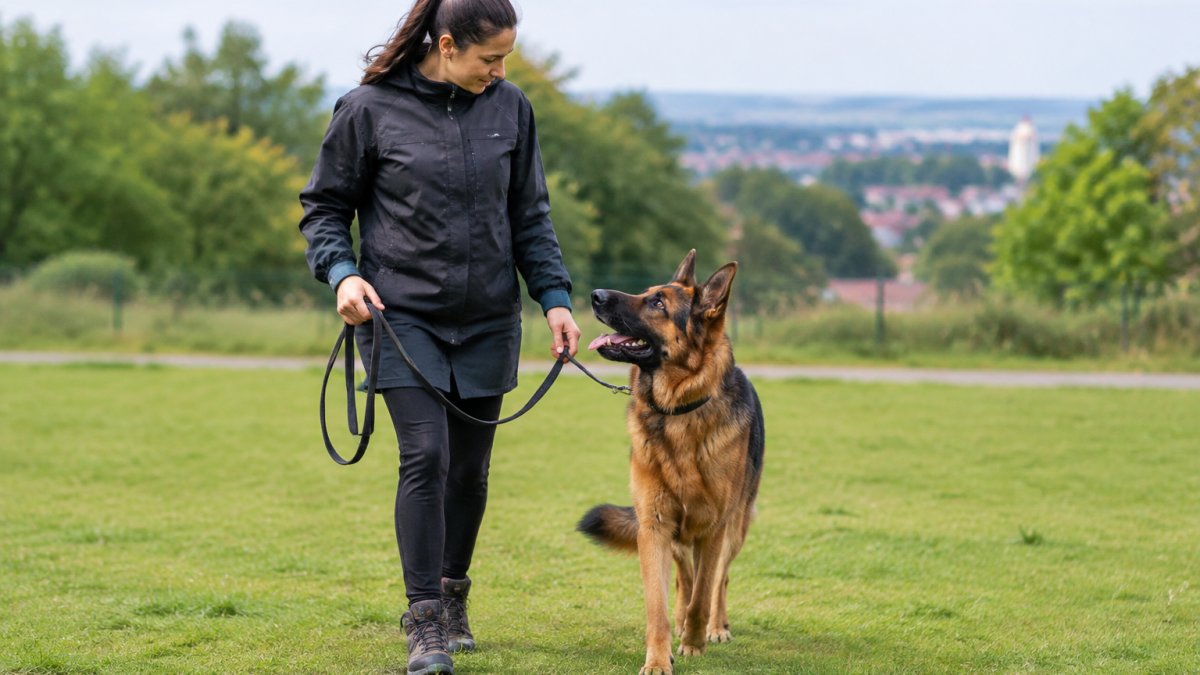
Keep the lead loose. A tight lead signals tension, so practise loose-lead walking in short sessions.
Use gradual exposure. Move closer to triggers in small steps, only as fast as your dog stays calm.
Practise regularly. Short, frequent sessions beat long, tiring ones.
Track progress. Log how close you can get before your dog reacts each week, and expect setbacks.
The steps below summarise how to retrain lunging and barking on walks.
Step | What to do | Time or frequency |
Find your dog's threshold | Note the distance where your dog notices a trigger but stays calm | Work at that distance |
Create space | Cross the road or turn around early | Early, before reacting |
Reward calm behaviour | Give small, high-value treats for calm looks | The moment your dog stays composed |
Keep the lead loose | Practise loose-lead walking in short sessions | Short sessions |
Use gradual exposure | Move closer to triggers in small steps | Only as fast as your dog stays calm |
Practise regularly | Hold short, frequent sessions | Short and frequent |
Track progress | Log how close you can get before a reaction | Each week |
Booking Your Free 1:1 Assessment in Reading
Every dog is different, and a plan that works for one may not suit another. At White Wolf Dog Training, we offer one-to-one support for owners across Reading and the surrounding areas. To find out what would work for your dog, book your FREE no obligation 1:1 assessment today.
Frequently Asked Questions
How do I stop my dog lunging on the lead?
Start by keeping your distance from the trigger, so your dog stays below its threshold and can still think. Mark and reward calm behaviour as the trigger comes into view, then gradually reduce the distance over several short sessions. Use a well-fitting harness and a non-retractable lead for safety. Progress is usually gradual, so expect steady improvement over weeks rather than overnight. If lunging is getting worse or you feel unsafe, speak to a qualified trainer for a one-to-one plan.
What is a dog's reactivity threshold?
A dog's threshold is the distance from a trigger at which it can still take in information, respond to its handler and take food. Within threshold, your dog can learn; over threshold, it is typically too aroused to do so. Signs of nearing threshold include stiffening, fixed staring, hard breathing, and ignoring food. The threshold differs between dogs and between triggers, so observe your own dog closely and work just inside it.
When should I seek professional help for a reactive dog?
Consider getting support if lunging or barking is escalating, if you feel unable to walk your dog safely, or if the behaviour is causing stress at home. A one-to-one assessment lets a trainer review your dog's history, identify its triggers and build a plan suited to your situation. White Wolf Dog Training offers a free, no-obligation 1:1 assessment for owners in Reading and the surrounding areas.
Comments